
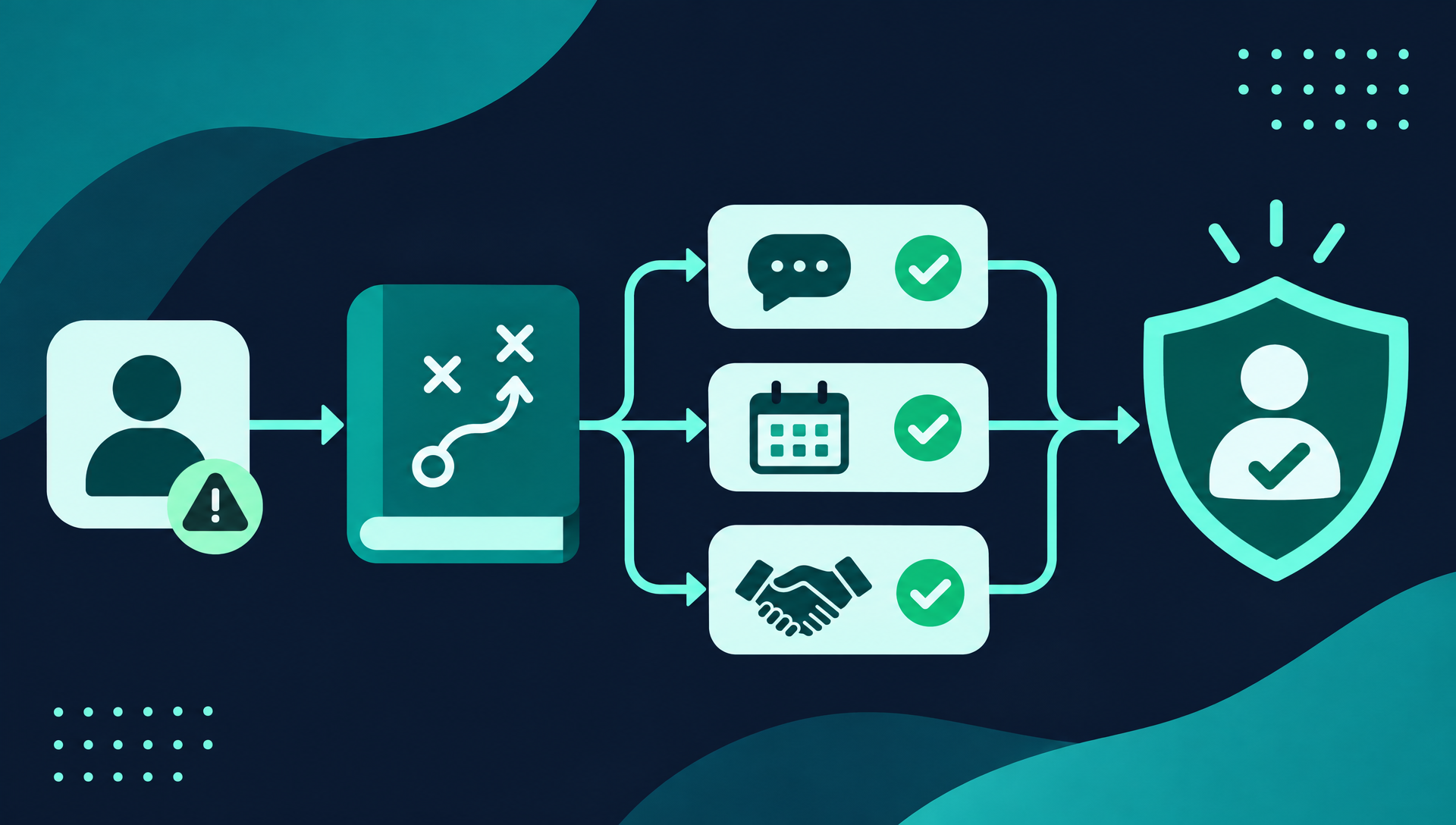
An account drops to “High” risk on a Monday morning. One CSM sends a check-in email. Another calls right away. A third waits until the next scheduled QBR. Three at-risk accounts, three different responses, three different outcomes, and no way to know which approach would have worked best.
This article walks through how to build a customer save playbook: a repeatable, timed sequence of actions your CS team follows every time an account crosses a risk threshold. By the end, you will have a framework you can adapt to your own segments, risk levels and team size.
Key takeaways
- A save playbook removes guesswork by defining when each action happens and who owns it.
- The best playbooks start with a clear trigger tied to a health score threshold, not a gut feeling.
- Measuring outcomes per stage lets you tighten the playbook over time instead of rewriting it from scratch.
What a customer save playbook actually is
A customer save playbook is a documented sequence of tasks, messages and escalation points that a CSM follows when an account shows signs of churn. It is not a single email template or a one-off discount offer. It is a process with a defined start, a set of timed steps, clear ownership and a measurable end state.
Think of it the way an incident response team thinks about a runbook. When the alert fires, you do not open a blank page and start brainstorming. You open the playbook and follow it, adapting the details to the account while keeping the structure consistent. That consistency is what makes save rates measurable and improvable.
A good playbook answers five questions before the CSM picks up the phone:
- What triggered this playbook?
- What should happen on day one?
- What follow-up actions happen and when?
- When does a manager or executive need to step in?
- How do we know if the save succeeded?
Start with the trigger, not the email
The most common mistake teams make is writing the outreach before defining the trigger. If your playbook starts with “send a check-in email,” you have already skipped the hardest part: deciding what counts as at-risk.
A trigger should be specific and observable. “The account seems disengaged” is not a trigger. “Health score drops from Healthy to Watch” is. So is “usage falls below 30% of the contracted seats for two consecutive weeks” or “the primary contact has not logged in for 14 days.”
The trigger determines which playbook runs. You will likely need more than one. An account that drops to Watch because of a billing dispute needs a different sequence than one where product usage is declining. Trying to handle both with the same playbook leads to generic outreach that sounds hollow to the customer.
Tools like health scores make triggers concrete. When a score crosses a threshold, the playbook fires automatically. No one has to remember to check a dashboard. No one has to guess whether an account qualifies.
Map the stages and timeline
Once you know what starts the playbook, map out every action that should happen and when. A save attempt is not a single conversation. It is a sequence that builds context, re-engages the customer and, if needed, escalates to someone with more authority or a different relationship.
Here is a sample timeline for a usage-decline playbook. Adjust the timing and actions to match your sales cycle, contract length and team structure.
| Stage | Timing | Owner | Action |
|---|---|---|---|
| Trigger | Day 0 | System | Health score drops to Watch due to usage decline. Alert sent to account owner in Slack. |
| Diagnose | Day 1 | CSM | Review the account’s health signals: which metrics dropped, when and by how much. Check recent support tickets. |
| Outreach | Day 1–2 | CSM | Send a personalized message referencing the specific change observed. Offer a 15-minute call to understand what shifted. |
| Follow-up | Day 3–5 | CSM | If no response, try a different channel (phone, LinkedIn, a message to the champion’s manager). Share a relevant resource or new feature update. |
| Value call | Day 7 | CSM | Conduct a focused call reviewing the customer’s goals vs. current usage. Identify gaps and create a 30-day action plan together. |
| Escalation | Day 10 | CS manager | If the account has not re-engaged, escalate to the CS manager for an executive-to-executive outreach or a concession discussion. |
| Resolution | Day 14 | CSM | Close the playbook. Log the outcome: saved, downgraded, lost or deferred. Update the health score notes. |
The exact days matter less than the principle: every stage has a deadline, an owner and a defined action. When the playbook is running, the CSM never has to ask “what should I do next?” They open the playbook and see.
Write outreach that references the signal, not the playbook
Customers can tell when they are getting a canned message. The fastest way to lose trust during a save attempt is to send something that sounds like it came from a sequence rather than a person.
Your playbook should include message templates, but those templates should have blanks that force the CSM to fill in specifics. Instead of “We noticed you haven’t been as active lately,” the template should read: “I noticed [specific metric, e.g., daily active users] dropped from [previous value] to [current value] over the past [time period]. I wanted to check in and see if something changed on your end.”
The health signals that triggered the playbook are the context the CSM needs. If the trigger was a seat-count reduction, say so. If product usage dropped after a specific feature was deprecated, reference that. Specificity shows the customer you are paying attention, not just running a script.
Three guidelines for save outreach:
- Lead with what you observed, not what you want. “I noticed your team’s usage of the reporting module dropped by half this month” lands better than “I’d love to schedule a call.”
- Offer something concrete. A usage review, a training session for new team members, or a configuration change. Not “let me know how I can help.”
- Keep it short. Three to five sentences. The goal is to start a conversation, not deliver a pitch.
Automate the trigger, focus on the conversation
Veermo’s save playbooks fire a timed sequence of tasks the moment an account crosses a risk threshold, so your team spends time talking to customers instead of watching dashboards.
Build in escalation paths before you need them
Not every save attempt will succeed at the CSM level. Some accounts need an executive-to-executive conversation. Others need a pricing adjustment that the CSM cannot authorize. If your playbook does not define when and how to escalate, the CSM either escalates too early (wasting leadership time) or too late (losing the account).
A good escalation path includes three things:
- A time-based trigger. If the account has not re-engaged by day 10, escalate. Do not wait for the CSM to decide the situation is bad enough.
- A revenue-based trigger. Accounts above a certain ARR threshold may warrant immediate executive involvement, regardless of the timeline.
- A clear handoff. The escalation message to the manager should include the account’s current health signals, what outreach has been attempted, and what the customer said (or did not say). No one should have to reconstruct the story.
Escalation is not failure. Frame it that way in your team. A CSM who escalates on day 10 with a complete brief is doing exactly what the playbook asks. A CSM who holds on until day 25 because they feel they should handle it alone is not following the process.
Measure outcomes, then tighten the playbook
The first version of your playbook will not be the best version. That is expected. What matters is that you capture enough data to improve it.
At a minimum, track these outcomes for every playbook run:
- Save rate. What percentage of accounts that entered the playbook returned to Healthy status within 30 days?
- Time to first response. How quickly did the CSM make first contact after the trigger? Did faster outreach correlate with higher save rates?
- Stage where the account re-engaged. Did most saves happen after the initial outreach, or did they require the value call or escalation? This tells you where the playbook is doing its best work.
- Reason for loss. When a save fails, record why. Pricing, product fit, champion departure, merger. Over time, patterns emerge that inform not just the playbook but the product and pricing roadmap.
Review these numbers monthly with your customer success team. Look for stages that consistently stall. If most accounts re-engage after the value call but not after the initial email, your email template may need work, or you may want to move the call earlier in the sequence.
A playbook you never update is a checklist. A playbook you update every month is a system.
Common mistakes that weaken save playbooks
After working through dozens of save workflows, a few patterns consistently undermine playbook effectiveness.
Vague triggers. “Account seems at risk” is not actionable. If two CSMs would disagree about whether an account qualifies, the trigger is too soft. Tie it to a score or a measurable event.
Too many steps. A 20-step playbook looks thorough on paper but stalls in practice. CSMs skip steps they see as busywork, and the playbook becomes aspirational rather than operational. Five to eight steps is a practical range for most teams.
No deadline for resolution. A playbook without an end date stays open forever. Some accounts will not be saved. Closing the playbook with a “lost” outcome after a defined period is not giving up. It is freeing the CSM to focus on accounts that can still be helped.
One playbook for all risk types. A billing-dispute account and a usage-decline account need different conversations. If your team is small and you can only maintain one playbook, start with usage decline. It is the most common pattern and gives you the most data to learn from.
No executive buy-in. If the CS manager is not looped in on escalation paths and the VP does not review save rates monthly, the playbook becomes a CSM-level exercise with no organizational backing. Make save outcomes a standing item in your leadership review.
Start with one playbook this week
You do not need to build five playbooks for every risk type before you start. Pick the most common churn pattern you see today, whether that is usage decline, support-ticket spikes or seat reductions. Write the trigger, the timeline, the templates and the escalation path. Share it with your team and run it for 30 days.
After that first month, you will have real data on save rates, response times and which stages matter most. Use those numbers to tighten the playbook, then build the next one. A single well-run playbook will protect more revenue than a folder of playbooks nobody follows.