Mobile apps have become an important part of the B2B SaaS experience. Employees use business applications to communicate, manage projects, track sales, review analytics, approve workflows, monitor operations, and stay connected while away from their desks.
For SaaS companies, this creates an important measurement challenge.
A user may continue paying for a subscription while gradually using the mobile app less frequently. At first, that decline may seem harmless. But if the reduction in usage continues, it can become an early warning sign that the customer is losing product value.
This makes mobile retention more complicated than simply asking whether an application is installed or whether a customer renewed their subscription.
A better question is: what does changing mobile usage tell us about the health of a B2B SaaS customer relationship?
There is no universal retention benchmark that applies equally to every B2B SaaS mobile application. Usage patterns vary significantly depending on the product category, user role, contract structure, workflow frequency, and whether mobile is the primary product or simply a companion to a web application.
However, businesses can establish meaningful internal benchmarks by monitoring active users, session frequency, feature adoption, engagement depth, and changes in usage over time.
What Does Mobile Retention Mean for B2B SaaS?
Mobile retention refers to the ability of a SaaS application to keep users returning and actively using its mobile experience over a defined period.
For consumer applications, retention is often measured using fixed time intervals such as Day 1, Day 7, or Day 30. B2B SaaS requires a more nuanced approach because the purchasing customer and the individual user may not be the same person.
A company might purchase a SaaS platform for 50 employees, while only 20 employees regularly use the mobile application. The contract may remain active even if mobile usage decreases.
That does not mean the decline should be ignored.
Mobile usage can provide insight into product adoption, workflow dependency, and user engagement. If employees stop using important mobile features, the SaaS provider may be seeing an early indication of broader adoption problems.
For companies investing in mobile app development, this distinction is particularly important. A mobile application should not simply reproduce the desktop interface on a smaller screen. It should provide useful workflows that encourage users to return when mobile access provides genuine value.
Why B2B SaaS Mobile Retention Is Different From Consumer App Retention
Consumer applications often depend on frequent engagement.
A social network, entertainment platform, gaming application, or shopping service may expect users to open the app several times a day.
B2B SaaS applications operate differently.
A project management platform may be used several times a week. An expense management application may be used only when expenses need to be submitted. A business analytics application may receive heavy usage around reporting periods but little activity during other times.
Therefore, low daily activity does not automatically indicate churn risk.
This is why SaaS companies should avoid using consumer-app retention benchmarks as universal standards.
The correct benchmark depends on the job the product performs.
If a product solves a daily operational problem, declining daily usage may be concerning. If the product solves a weekly or monthly problem, a lower frequency can be completely normal.
The first step is therefore to define what healthy usage looks like for the specific product.
Which Mobile Usage Metrics Matter Most?
B2B SaaS companies should monitor more than the number of app opens.
Useful metrics include:
- Daily active users
- Weekly active users
- Monthly active users
- Sessions per active user
- Session duration
- Feature adoption
- Frequency of key actions
- Push notification engagement
- Mobile-to-web activity
- User inactivity periods
- Account-level active user percentage
- Retention by customer cohort
- Churn among low-engagement accounts
These metrics become much more useful when viewed together.
For example, a decrease in session frequency combined with lower usage of a core feature is more concerning than a simple decline in total app opens.
Similarly, a customer account with 80% of its users still completing important workflows may be healthier than an account with more frequent but shallow activity.
The goal is to understand meaningful product engagement, not just screen activity.
What Is a Healthy Retention Benchmark?
There is no single mobile retention percentage that can accurately define success for every B2B SaaS product.
The reason is straightforward: B2B applications have different usage cycles.
A customer relationship management platform may be used throughout the working day. A workforce management platform may be used every shift. A financial reporting application may have heavier usage near the end of a month. A project management application may be used throughout a project lifecycle.
Instead of asking whether an application achieves a specific industry-wide retention number, SaaS companies should establish benchmarks around their own customer behavior.
For example, a business might monitor:
Weekly active account users: What percentage of licensed users are active each week?
Core feature adoption: How many users complete the actions that represent genuine product value?
30-day activity: How many users remain meaningfully active one month after onboarding?
Usage decline: How many accounts experience a significant reduction in activity?
Reactivation: How often do inactive users return after targeted engagement?
These measurements can create a much stronger retention framework than relying on one generic benchmark.
When Usage Drop-Off Becomes a Churn Signal
A reduction in mobile usage does not automatically mean a customer is about to cancel.
It becomes more meaningful when several negative signals appear together.
For example, imagine a customer account where weekly active users fall by 30% over three months. At the same time, users stop engaging with important features, fewer employees log in from mobile devices, and customer support requests begin to decline.
At first, the lower support volume might look positive.
But combined with reduced product usage, it could indicate that the customer is becoming less dependent on the platform.
This is where SaaS teams need to distinguish between normal usage variation and behavioral deterioration.
A single inactive week may mean nothing.
A sustained decline across several weeks can be much more informative.
The First Warning Sign: Reduced Frequency
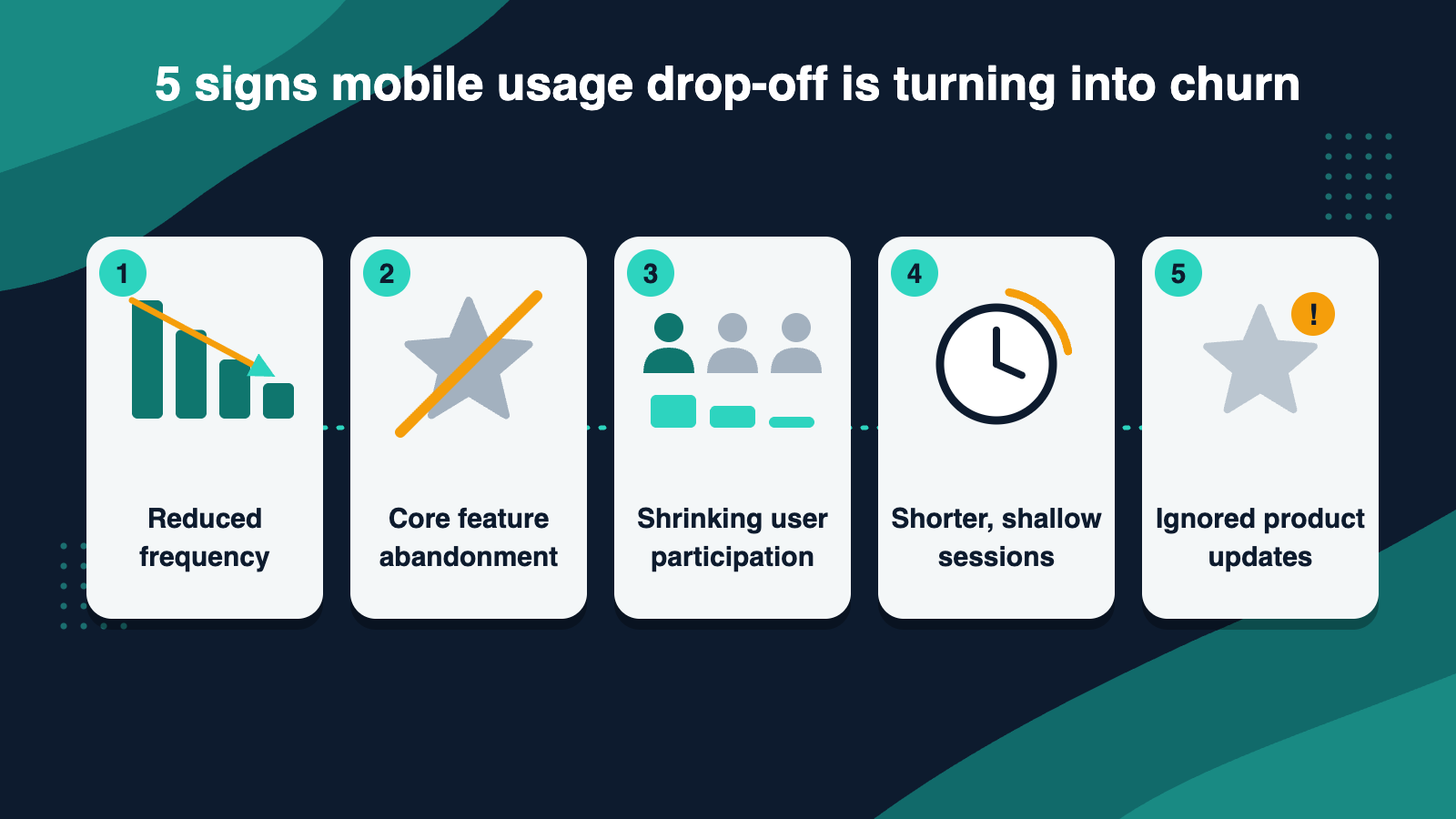
One of the earliest signals of declining engagement is reduced usage frequency.
A customer who previously used an application five times per week may gradually drop to three sessions, then one, and eventually stop using the mobile app altogether.
The important factor is the trend.
SaaS teams should establish a baseline for each customer segment and monitor significant changes from that baseline.
For example, instead of creating a universal rule that “three sessions per week is healthy,” a company could identify that its successful long-term customers typically use a particular feature four or five times per week.
That creates a product-specific benchmark.
The Second Warning Sign: Core Feature Abandonment
Not every feature matters equally.
A user may stop opening a dashboard but continue submitting approvals, assigning tasks, or completing another critical workflow.
In that situation, overall activity may decline without creating immediate churn risk.
The opposite is more concerning.
If users stop engaging with the feature that delivers the product's core value, the business should investigate.
For example, if a sales SaaS platform is purchased primarily to manage leads but users stop updating or reviewing leads, the company may be experiencing an adoption problem.
Feature-level retention can therefore provide more useful information than overall login frequency.
The Third Warning Sign: Shrinking User Participation
B2B SaaS products are often purchased at the account level but adopted at the employee level.
This creates another important retention metric: account penetration.
Suppose a company licenses software for 100 employees.
Initially, 75 employees actively use the platform.
Six months later, only 40 remain active.
The customer may still be paying for all 100 seats, but the product's internal adoption is weakening.
This can become a significant churn risk because the customer may eventually question why it is paying for software that fewer employees use.
Tracking the percentage of licensed users who remain active can help SaaS companies identify this problem earlier.
The Fourth Warning Sign: Shorter Sessions and Shallow Engagement
Session duration can also provide useful context.
However, shorter sessions are not automatically negative.
A well-designed SaaS application can allow users to complete tasks faster. In that situation, shorter sessions may actually indicate better usability.
The important question is what happens during the session.
If users previously completed several valuable actions but now open the app briefly without completing meaningful workflows, engagement may be weakening.
This is why session quality is more useful than session duration alone.
Product teams should analyze what users actually accomplish during their sessions.
The Fifth Warning Sign: Ignored Product Updates
Another potential signal is declining interaction with new features or product improvements.
If a SaaS provider launches a feature designed to solve a major customer problem but the target users never adopt it, there may be a product education or product-fit issue.
This does not automatically mean churn.
However, repeated failure to adopt relevant functionality can indicate that customers are not discovering enough additional value from the platform.
Customer success teams can use this information to identify accounts that may need training, onboarding support, or targeted feature education.
Push Notifications Can Help — But They Cannot Fix Weak Product Value
Mobile notifications are often used to bring inactive users back into an application.
They can be useful for reminders, approvals, task updates, alerts, and time-sensitive actions.
But notifications should not become a substitute for product value.
Sending more notifications to a user who has stopped seeing meaningful value can create notification fatigue instead of improving retention.
A better approach is to make notifications contextual.
For example, a project management application could notify a user about an important task assignment. A finance application could alert an approver when a payment requires action. A customer support platform could notify a manager about a high-priority ticket.
The notification should provide a reason to return.
Why Context Matters in Mobile SaaS Retention
Different SaaS products have different natural engagement patterns.
A communication application may require frequent daily use.
A workforce management platform may follow employee shifts.
A financial application may have periodic usage.
An enterprise analytics platform may have fewer but more meaningful sessions.
This means retention analysis should consider context.
Businesses should segment users based on:
- Industry
- Job role
- Customer size
- Subscription tier
- Product maturity
- Frequency of use case
- Mobile dependency
- Geographic region
- Onboarding stage
A benchmark that is healthy for one segment may be weak for another.
Segmentation prevents SaaS teams from misinterpreting normal behavior as churn.
Comparing Mobile Usage With Web Usage
Another common mistake is looking at mobile usage in isolation.
Some B2B SaaS products are primarily web-based. Their mobile applications may exist for quick actions, alerts, approvals, or monitoring.
In such cases, a decline in mobile usage may not indicate customer disengagement.
Users could simply be completing more work through the desktop interface.
This makes cross-platform behavior important.
A customer who stops using mobile but increases web activity may not be at risk.
A customer who stops using both mobile and web channels is a much stronger churn candidate.
SaaS companies should therefore build a combined engagement view across devices.
How Live-Use Platforms Demonstrate the Importance of Engagement
The relationship between usage and retention becomes particularly obvious in highly interactive digital products.
Consider businesses working on products such as a live streaming shopping app development project. The platform's success depends heavily on repeat engagement, session activity, content interaction, and the user's decision to return for another live shopping experience.
B2B SaaS products may have different usage patterns, but the underlying principle is similar: behavior reveals whether users are finding continuing value.
The difference is that B2B SaaS teams need to interpret that behavior according to the customer's actual workflow rather than assuming that more sessions always equal better retention.
Creating an Early Churn Detection System
Once SaaS companies understand their usage patterns, they can create an early-warning system.
The system can combine multiple signals into an account health score.
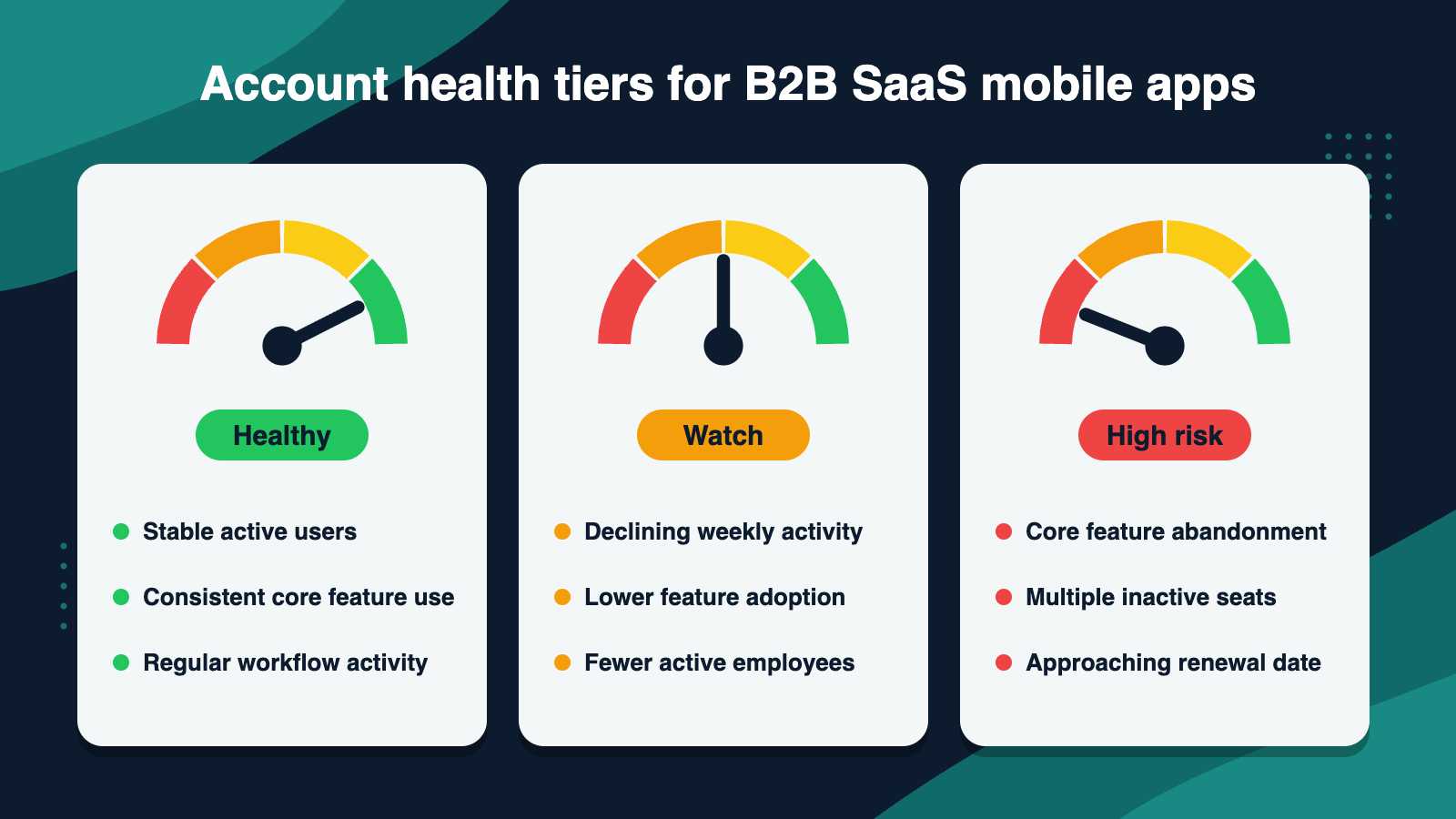
For example:
Healthy account
- Stable active users
- Consistent core feature usage
- Strong onboarding completion
- Regular workflow activity
- Positive customer feedback
Watch account
- Declining weekly activity
- Lower feature adoption
- Reduced number of active employees
- Fewer completed workflows
- Increased unresolved support issues
High-risk account
- Major usage decline
- Core feature abandonment
- Large reduction in active users
- Multiple inactive seats
- Negative customer feedback
- Approaching renewal date
The exact scoring system should be customized to the product.
The important part is that the company identifies declining behavior before the renewal conversation.
What Should SaaS Teams Do When Usage Falls?
Identifying a churn signal is only useful if the business responds appropriately.
The first step should be investigation. Customer success teams should determine why usage has changed.
Possible reasons include:
- The customer completed the original project.
- The company changed its internal processes.
- Users were not properly trained.
- A key employee left.
- The product is difficult to use.
- A competitor has been introduced.
- A critical feature is missing.
- The customer is experiencing technical problems.
- The product is no longer considered essential.
The correct response depends on the reason.
A training problem requires education.
A product problem may require product development. A technical issue requires engineering support. A pricing problem may require commercial discussion.
Assuming every usage decline means the customer needs a discount is usually the wrong approach.
Retention Should Influence Product Development
Usage data should not remain inside the customer success department.
Product teams can use retention data to decide what needs improvement. If customers repeatedly abandon a particular workflow, the company can investigate usability.
If users frequently access one feature but ignore another, the product team can examine whether the ignored feature provides enough value. If mobile users repeatedly request the same functionality, that can influence the mobile roadmap.
This creates a feedback loop:
Usage data → Customer insight → Product improvement → Better adoption → Stronger retention
That loop can become one of the strongest advantages of data-driven SaaS development.
Building Better Mobile Retention Benchmarks
Rather than copying a benchmark from another company, B2B SaaS businesses should build their own.
Start by identifying the behaviors associated with long-term customers.
Look at customers who have renewed repeatedly. Analyze how often their users log in, which features they use, how quickly they complete onboarding, and how many employees actively participate.
Then compare those patterns with accounts that eventually churned.
The differences can reveal useful leading indicators. For example, a company might discover that customers with more than 60% weekly active seat utilization have substantially better retention than accounts below 30%.
That finding becomes more valuable than a generic industry benchmark because it is directly connected to the company's own product and customers.
Conclusion
Mobile usage can provide SaaS companies with an important window into customer health, but there is no universal retention benchmark that determines whether a B2B SaaS application is successful. The right benchmark depends on the product's purpose, customer workflow, user roles, and expected frequency of engagement.
The most useful approach is to monitor changes over time. Declining session frequency, reduced core-feature adoption, shrinking account participation, and weaker cross-platform activity can become meaningful churn signals when they appear together.
Triple Minds can support businesses that need to connect mobile product development with broader technology and digital growth requirements. But regardless of the development partner, the underlying strategy remains the same: build the mobile experience around meaningful customer workflows, measure the behaviors that indicate value, and respond before declining usage becomes lost revenue.
For B2B SaaS companies, retention is not simply about keeping an app installed or getting users to log in every day. It is about ensuring that customers continue to rely on the product because it remains useful to their business.
The strongest mobile retention strategy is therefore not about maximizing app opens. It is about maximizing meaningful product value. When usage data, customer feedback, product development, and customer success work together, SaaS companies can identify churn risks earlier and turn retention into a measurable part of long-term growth.